SEO for Birth Workers: What Actually Matters (and What You Can Skip)
A while back I taught a marketing (SEO, websites, social media) workshop for a room full of doulas, and somewhere in the middle of it, someone typed a question into the chat that feels oh so familiar.
She wanted to know whether it was worth putting energy into social media just to make herself look legitimate to search engines. And then she added: "At what point does it feel like there's a tipping point toward value?"
That's the real question, isn't it. Not "how do I do SEO." More like: how much of this do I actually have to care about so that it starts giving me something back?
So let's talk about SEO for birth workers, and especially, what's worth your time and what you have my full permission to ignore.
First, a reframe about how people actually find you
Most SEO advice is written for businesses where a stranger searches, clicks, and buys. But let’s be so for real: that is not how anyone hires a doula.
Someone else in that same workshop described it perfectly. She said people probably aren't stumbling onto her Instagram and thinking oh, she’s perfect, I'll hire her! They're hearing about her from their provider, a Google search, her website, or a client, and then going to social media to get a sense of her energy and beliefs.
That's the actual sequence. And it changes what SEO is for.
Search isn't replacing word of mouth in this field. Most of the time, parents are checking several sources, so when they do search for your business, the SEO work you’ve done is catching the people that word of mouth already sent looking. Someone's midwife mentions your name. A friend says, "Look up this postpartum doula in Tacoma." A hospital hands out a list. And then that person goes and types something into Google.
Your job is to be findable and identifiable at that moment, not to out-rank the entire Internet.
SEO that actually matters
Say what you do the way that your clients say it.
Birth workers use a lot of lovely words to describe the support we offer. We say "perinatal support professional" and "full-spectrum doula" and "evidence-based birth support."
Clients, on the other hand, type "night nanny," "doula near me," "help with newborn sleep," "lactation consultant [their town]."
Search engines and AI are trying to match providers with clients. But if your website only uses the professional version, you're invisible to the person using the more typical language. Mirror your clients’ language on your website, and sprinkle your credentials in for trust; their words matter a lot for being found.
Your name and location should appear more than you think.
At that workshop, another attendee asked whether it was enough to use just her first name across her site, or whether Google needed her first and last. Her instinct said first name felt more natural.
In this case, use both, at least somewhere on every key page. "Hi, I'm Jenny Lastname, a postpartum doula based in north Seattle." Your full name and your service area are two of the strongest signals you can give, and they're the two things most birth workers leave out because saying your own full name on your own website feels strange
It does feel strange, but do it anyway. This way whenever you partner with someone and they list your name and city as a resource, it reinforces the understanding Google has of who you are, what you do, and what kind of traffic to send your way. When I'm writing or rebuilding a birth worker's website, this is one of the first things I add back in: full name, credentials, and local service area worked into the copy in the places where a person would actually say them out loud.
Answer the questions people are actually typing.
The highest-value pages on a birth worker's site are almost never the pretty ones. They're the ones that answer a specific question a tired person types at 2am. What does a postpartum doula actually do? How much does a birth doula cost in Seattle? Do I need a night nurse or a postpartum doula? For my doula website, the most clicked on phrases were virtual postpartum doula, postpartum prep, and where to put a newborn.
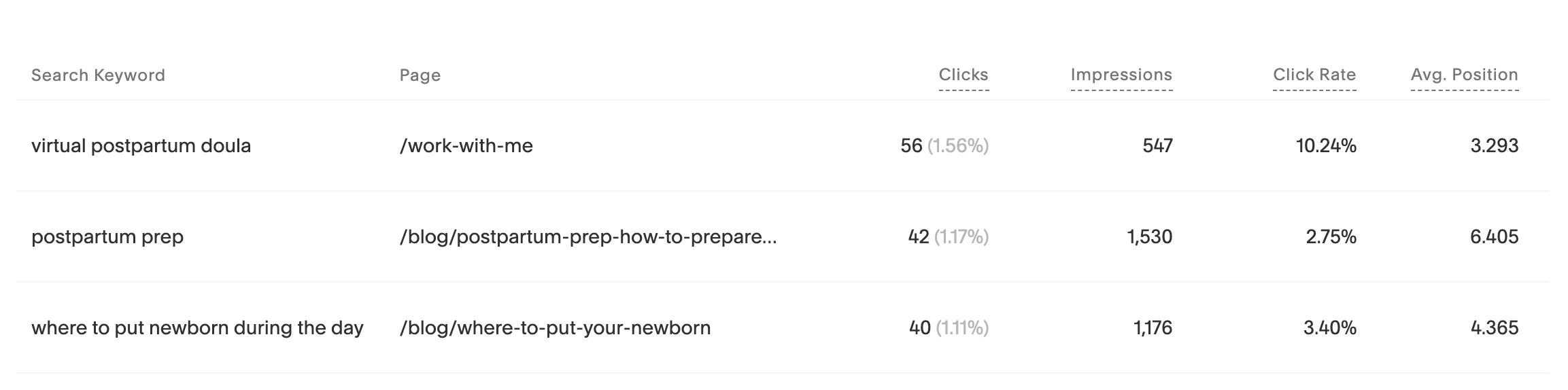
👆This kind of keyword information tells me whether my SEO is “working” and helps me decide my next steps.
You can answer the questions you get most often, whether about your work or your packages, or about babies or parenting or your speciality in blogs, or even just in FAQ sections on your services page, or on your about page.
You already answer these questions constantly in consults, in DMs, in Facebook groups. Write down the answers you're already giving and just like that, your content is strategic.
Claim your Google Business Profile.
Someone else in that workshop asked how her Google Business page fit into all this, which is such a good question. For local service work, your Google Business Profile can do a lot of quiet heavy lifting. It shows up in map results, it's often the first thing someone sees, and it takes about twenty minutes to set up.
Reviews here are worth more than any of your own posts on it. If you do one thing this month, ask two past clients to leave one.
For more on how to audit or rewrite your website so both search engines and AI tools can actually make sense of it, read this article next.
Here’s what you can skip for SEO
Posting constantly to seem legitimate.
Back to that chat question: does social media make you a legitimate human to the search engine? Not really, no. Your social profiles aren't a meaningful ranking factor. Social media is where people check out your vibes, usually after they've found you, which is a real job, but SEO isn’t going to help you with that.
So if Instagram is draining you, that's a reason to do less of it or to try a different approach, but not a reason to overhaul what’s happening on your website.
Constantly "noodling" your site to stay fresh.
That workshop attendee also asked how often we should all be going in and updating things on your website. She'd been told making regular updates or even micro-changes helps Google pay attention to you, and she wondered if that was legitimate advice
For the most part, updating a page for the sake of updating doesn't signal anything meaningful to Google. Updating it because something is genuinely out of date, or because you've written something new and useful, does. If your rates have changed, fix them. If your headshot is from a previous era of your hair, sure, fix that too. But Google won’t rank you a bit higher because you swapped out some language or graphic for others while your competitor hasn’t touched their site in 2 years.
Keyword tools, competitor dashboards, etcetera.
You don't need SEO software, analytic dashboards, or any other gimmicky tool to make meaningful improvements. Your website should plainly describe your own services, name your own town, and answer the questions your clients ask. That way, search engines and AI will get a clear picture of who to send to your website, and those folks will get exactly what they’re looking for (and hopefully reach out to hire you!).
Back to the tipping point
And so, the honest answer to the question — when does this start being worth it — is that SEO for birth workers pays off slowly and then keeps paying off without you touching it.

Grab the SEO Guide here 👆
And this is the opposite of social media, where the effort is constant and the payoff evaporates in about forty-eight hours. Someone in that same workshop said making a post takes so long that the benefit ratio feels off and she was right. It often is.
A page that answers a real question and names your town is still working eighteen months from now while you're asleep. That's the trade you make when you focus on your website and SEO versus social media. Yes it’s slower to start, and yes, it’s much lighter to maintain.
Just remember, you don't have to do all of the things for SEO to work for you. It can pull its weight right alongside provider and past client referrals, a light social media presence, and your attendance at a couple of birth worker meet ups per year. Do those, and families will find you.
If you want to go through your own site properly, I put together a free SEO guide for birth workers. It walks you through what to check and what to fix, in plain language, with the option of leaning on AI through this process.
