How to Do Marketing When Marketing Isn’t Your Job

Have you ever sat down to “do marketing,” stared at a blank screen, and thought… I don’t even know where to start?
This was a constant low-level dread I lived with early in my postpartum doula days.
To quiet the worries, I started following business and marketing coaches and downloaded all their social media calendar templates, post ideas, and caption generators, just so that I would know what to write when it came to promoting my little business online.
But it was tricky because they were either too polished or too hype-y for the birth and new parenting space, so it still took me an hour or more to figure out how to use the “short cuts” they offered and turn it into a post I felt good enough about to share.
If you’re a birth worker, doula, newborn care specialist, or any kind of small business owner who got into this work because you love supporting families (not because you love marketing) this is for you. Especially if the part where you talk about your work online and do self-promotion feels awkward, confusing, and honestly kind of exhausting.
But here’s what I know from the other side of building a whole system around this: there is a better way that won’t leave you feeling so squirmy.
When marketing starts to feel like a natural extension of your work instead of a whole separate job you have to drag yourself to, almost everything shifts. It’s easier to post with more ease. You feel your confidence growing. Parents start to recognize your voice and trust your perspective before they’ve even reached out. And the more comfortable you get talking about your work online, the easier it becomes to talk about it everywhere else, too: with potential clients, with other birth workers, and with perfect strangers who somehow have never heard of a postpartum doula before.
In this post, I’ll walk you through the four steps that make this possible. (And yes, I’ve turned this into a free guide you can grab along the way, more on that in a moment.)
Ready? Let’s go.
Step 1: Decide What You Actually Stand For (Your 3 Core Messages)
One of the biggest reasons marketing feels exhausting is that every post feels both really important and also like you don’t know where to start.
You sit down and think: What should I say today? And suddenly the pressure is on to come up with something original, thoughtful, educational, and persuasive all at once. That blank screen is daunting. No wonder we put it off!
Your core messages change this completely.
Your core messages are the handful of ideas you come back to, again and again, in your work. They are the beliefs and perspectives that shape how you support families. For a postpartum doula, these might sound like:
Supporting parents in trusting their own instincts
Normalizing the emotional complexity of early postpartum
Helping families build calm, sustainable rhythms with a newborn
As a postpartum doula, I inevitably returned to these three themes in all my writing:
You don’t have to figure everything out alone and support changes everything
You can prepare for a more calm, confident postpartum experience
You can learn to trust your instincts and desires as a new parent
All my offers, resources, and support orbited around these core ideas and writing about them was almost too easy.
When you know your three core messages, marketing stops being about constant invention. Every post becomes a new angle on something you already believe. You might tell a client story one week, share a quick tip the next, or gently push back on a common myth. But underneath it all, those same anchoring ideas keep showing up. And if that feels repetitive, fine! It should. That’s how you develop a recognizable brand voice.
Not sure what your three messages are? Your website is likely your best place to start. Open it up and look for the themes you already repeat: what you do, who your work is for, what makes your approach different. Those aren’t background details. They’re your content anchors.
And if you want to turn those ideas into social content more easily, The Calm Visibility System walks you through exactly this: how to identify your three core messages and use them as the foundation of everything you post. Grab the free guide here.
Step 2: Give Every Post a Job (Not Every Post the Same Job)
Once your core messages exist, there’s still one more thing that makes posting feel harder than it needs to be: we try to do everything in one post.
We want to educate, build trust, promote our services, answer questions, and come across as warm and approachable so that someone will book us… all in a single Instagram caption, even though we know that’s a lot to ask from a few well-written sentences and a photo.
Let’s keep it simple instead and let each post do just one job.
In the system I teach, posts fall into three categories:
Informational posts teach something useful like how newborn sleep actually works, what postpartum support looks like in real life, the advice parents need to hear over and over again.
Trust-building posts share your perspective, your stories, and your behind-the-scenes (like what’s in your doula bag, or how you are spending your day off) so that families get to know and trust you.
Promotional posts talk directly about working with you, your availability, your services, your booking process, and what support from you actually feels like.
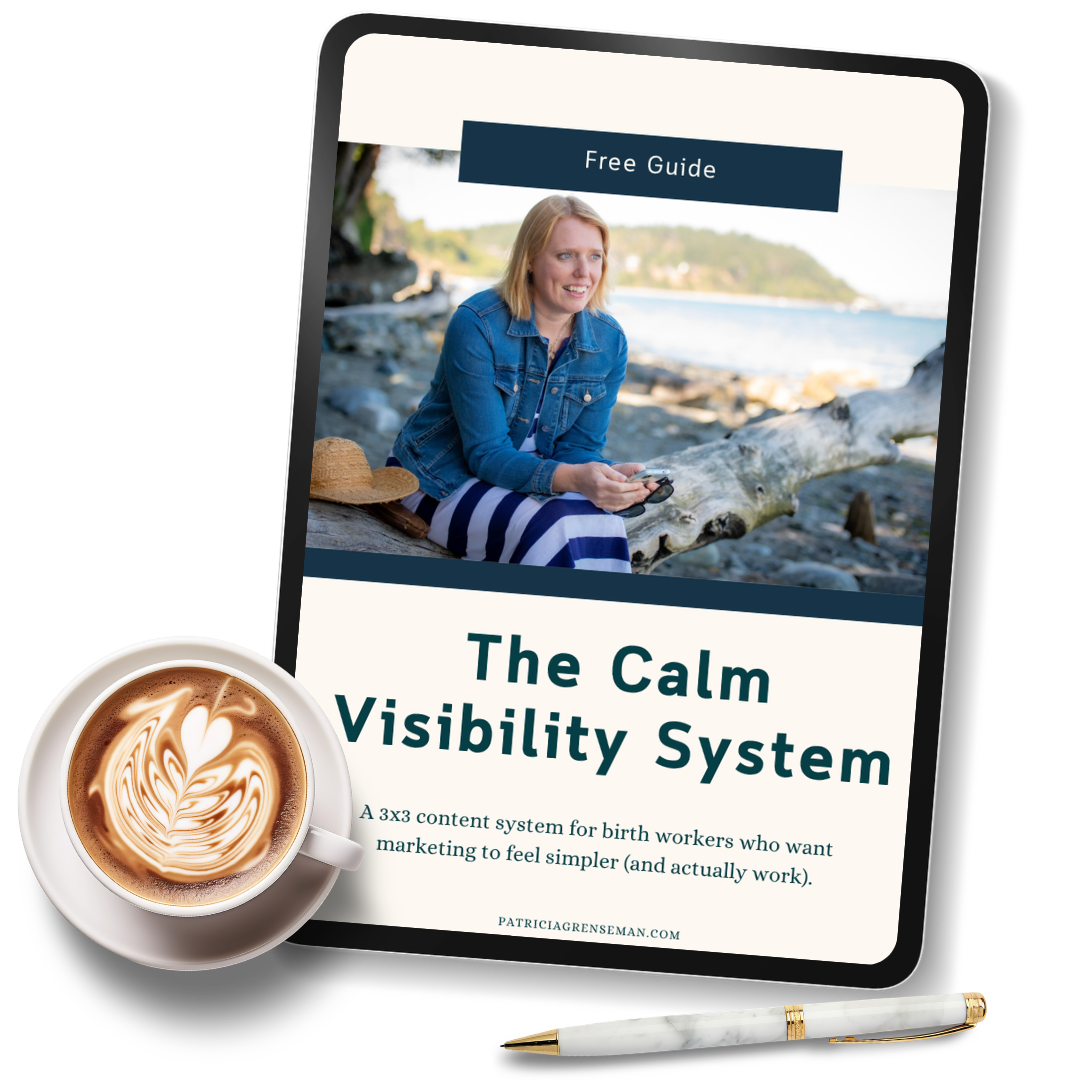
Grab the free guide to make your marketing feel lighter.
When you separate these out, posting gets dramatically simpler. You’re not trying to accomplish everything at once. You’re just sharing each thing, one-at-a-time, a few times per month.
This is where the 3×3 grid comes in. It maps your three core messages across the three post types, giving you nine repeatable content angles you can rotate through week after week. Nothing is brand new. It’s all reinforcement, just expressed in different ways.
The Calm Visibility System includes a 3×3 filled-in example grid template plus an empty one for your biz so you can build yours with your own messages, in your own words. Get your free copy here.
Step 3: Build a Rhythm, Not a Content Calendar
After six years in the online marketing space, I can tell you that most marketing advice centers on building a content calendar. Plan out thirty days of posts and map it all out so you can post strategically.
But for birth workers who are already managing client schedules, overnight shifts, and are also the primary caregiver and housekeeper at home, that’s just not realistic.
What works better — and what I’ve seen make a real difference for the birth workers I support — is a rhythm.
A simple rhythm might look like this: three posts a week, three types of posts, three core messages. That’s it. You’re just rotating through combinations you’ve already defined. An informational post about message one. A trust-building post about message two. A promotional post about message three. The next week, you shift one column to the right.
The blank-page problem disappears. Instead of inventing something new every time you sit down, you’re revisiting familiar ideas from a different angle. And that consistency, that predictable, steady voice, is exactly what builds recognition and trust over time.
I want to be crystal clear: you don’t need to post every day or everywhere. And aiming for originality could actually be working against you. Keep it simple and use a sustainable rhythm you can keep up with.
Step 4: Use AI to Get the Idea Out of Your Head and Onto the Page
What about if your biggest challenge isn’t that you don’t know what to say but that you just can’t seem to get all your ideas out and organized?
After all, you have the expertise and the perspective. You have years of client stories and hard-won insights. But somewhere between your brain and the blank caption box, it all gets stuck.
This is exactly where AI (like ChatGPT or Claude or Gemini) becomes useful. My favorite way to lean on AI is as a thinking partner that helps me get my ideas out of my head and into a shape I can work with.
The way I teach it inside AIME: you bring the spark, AI helps you draft. You might say, “I want to write a post about why I don’t think parents should sleep train at six weeks. Here are the worries I think are underneath it all, and these are my reassurances.” And then you let it generate a starting point you can edit, adjust, and make sound like you.
This is important: the content doesn’t come from AI. It comes from you. AI just removes the friction of getting started. And for busy birth workers who already have plenty of friction in their days, (or any human living through this first half of 2026) that matters.
Another way I like to use AI is to tell it a story about something really helpful I wrote in a client email, or share something I said in a consult that landed well. Sometimes, those ideas make valuable content for people in my audience. Those beautiful moments of clarity can become a helpful story you share about your business. AI is just the tool that connects your idea with your audience.
We do this on repeat inside AIME, my marketing support membership. Every Monday you get five prompts designed to help you use AI to stay visible in a way that sounds like you, without starting from scratch every single week.
You Might Be Wondering…
Even with a solid system, a few worries tend to come up. Let me address them quickly.
“Won’t people get bored if I repeat myself?”
You are the only one keeping track. Most people see only a fraction of what you post, and even the ones who see more aren’t cataloguing your themes. And anyway, in the world of birth work, repetition is actually highly valuable. It’s how people begin to recognize you. Consistency, not novelty, builds trust.
“Why bother if no one sees my posts anyway?”
This one is real, and I don’t want to brush past it. In fact, I wrote a whole blog post about this earlier this year. Still, I believe that the value of posting isn’t only in that post’s immediate reach. A big part of it is practice: practicing how to talk about your work, practicing your voice, practicing being visible as a person with a business. That confidence compounds over time. And one day someone will message you and say, “I’ve been following you for months… I’m ready.”
“Posting still takes forever.”
It takes forever when you’re inventing something new every time. With your messages defined, your grid built, and a starter prompt waiting in your inbox every Monday, thanks to AIME, the whole thing can honestly take about ten minutes and feel way less stressful.
Bringing It All Together
Marketing for your birth business doesn’t have to feel like a second job. When you simplify the structure, it becomes something much more manageable that you can actually fit into a Tuesday morning before the kids wake up, or a quiet twenty minutes between client visits.
Here’s the recap:
Define your three core messages so you always know what to talk about next.
Give every post one job so you’re not trying to do everything at once.
Build a rhythm, not a calendar so you’re rotating through familiar ideas instead of inventing new ones.
Use AI to get unstuck so the ideas in your head can actually make it onto the page.
When you approach marketing this way, everything shifts. Posting becomes faster. Your voice becomes clearer. Parents begin recognizing your work and trusting your perspective long before they reach out. And the more comfortable you get talking about your work online, the easier it becomes to talk about it everywhere else too.
Your Next Step
Low-lift marketing is a skill that you can learn, and it gets so much easier with a little structure and a little support.
If you want to put this into practice, start with the Calm Visibility System, a free guide where you’ll build your own 3×3 posting grid and define the three core messages that anchor everything you share online.
And if you want ongoing support with prompts, structure, and a community of birth workers doing this alongside you, AIME is always open.
For $9 a month, you get five AI prompts in your inbox every Monday, a growing prompt library, and the kind of steady, calm marketing support that’s actually designed for people who are already doing the hard work of caring for families.
If that sounds like a breath of relief, I’d love to have you inside.
