Your Social Media Is a Waiting Room. Here's How to Furnish It.
What if every post had just one job to do?
A lot of birth workers sit down to post something and immediately feel the pressure of being ‘on’. You want to sound knowledgeable without being boastful. You want to stay visible without feeling like you're advertising yourself every five minutes. And you want to do all of this while also, you know, actually doing your work, which involves showing up for families in some of the most demanding moments of their lives.
No wonder posting feels hard.
But here's what I noticed about myself once I stopped asking each post to do everything at once: I started feeling more comfortable online, even though I wasn’t necessarily posting more, or better, or with fancier graphics.
This post is about a framework I call the Booking Journey. It’s my way of thinking about your social media content that might make the whole thing feel a lot more manageable.
A quick note before we dive in: when I say "marketing" throughout this post, I mostly mean your social media presence, so the posts, captions, and content you share online. That's the piece most birth workers find stressful, and it's where this framework lives. (Your website, your newsletter, your referral relationships, those are all marketing too, and worth a conversation, but we'll keep this one focused here for now.)
Your Social Media Is a Waiting Room
Here's a fresh way to think about your online presence that I have found helpful.
Before someone hires you, they spend time in your online waiting room. They scroll back through your last dozen posts. They read your bio. They click through your website’s pages. They spend a few minutes getting a feel for who you are and whether you seem like the right person to support them through something enormous.
What families find there matters because your content, over time, either answers their nervous questions or it doesn't. It either helps them feel like they know you a little before they reach out, or it leaves them uncertain.
The Booking Journey framework is essentially a way to furnish that waiting room intentionally so that whatever a family happens to land on, something useful happens for them and for your business.
It has three stations.
Station One: Show Them You Understand Their World
This is your educational or entertaining content that teaches something useful, answers a common question, normalizes an experience, or speaks directly to the worries your future clients are already carrying around.
Think about what families are searching for at 2am. The fears nobody is addressing clearly. The myths that keep circulating. The questions that feel almost too basic to ask a professional. That's the territory of the Information Station.
Maybe you're explaining what the first few weeks postpartum actually feel like. Maybe you're addressing a piece of misinformation about newborn sleep. Maybe you're naming the thing your clients consistently say “nobody told us!” before they hired you.
These posts do two things at once. For someone who's never heard of you, they establish your expertise before anyone has asked for your credentials. Your knowledge is just there, visible, being helpful in the feed. For someone who's already been quietly following you, these posts make families think: this person actually understands what I'm going through.
The Information Station isn't about explaining your services. It's about demonstrating that you understand your clients' world. That's what makes these posts shareable. People forward them because they're genuinely useful, not because they're impressed by your bio or branding.
Station Two: Let Them Feel Like They Know You
If the Information Station helps families understand your expertise, the Trust Station helps them understand you.
These are your values posts, your behind-the-scenes moments, your perspective on the work, the occasional story that shows what it's actually like to be supported by you. This content closes the emotional distance before any inquiry ever happens.
This matters more in birth work than in almost any other field. Families aren't hiring a service. They're inviting a person into a deeply vulnerable season, sometimes the most significant weeks of their lives. They want to know if they'll feel safe with you, whether your values align with theirs, and what kind of presence you bring into hard moments.
A post where you share why you got into this work does something no amount of credentials can do. A reflection on what it felt like to support a family through a challenging birth, or a quiet thought about the honour of postpartum care are the exact kinds of posts that warm the waiting room. They help someone feel like they know you before they've ever sent a message.
And a values post can be effective without being about birth work at all, too. A post where you share your Costco haul or photos from the hike you did on the weekend, or even why you admire a certain mentor in the field tells families what’s important to you and gives them a glimpse into the kind of person you are.
Station Three: Open the Door and Invite Them In
This is the one many birth workers avoid.
The promotional content. Your availability, your offers, what working with you actually looks like, how someone takes the next step.
A lot of caring professionals feel uncomfortable here. It can feel like suddenly switching from "supportive professional" to "person who is trying to sell something." But this station matters just as much as the others, and skipping it is not going to lead to more inquiries..
Here's the thing: a family can trust you, learn from you, and genuinely love your content and still never reach out if there isn't a clear invitation. People are busy. And when they’re online, they’re distracted and overwhelmed. Sometimes they genuinely don't know what the next step looks like unless you make it obvious and tell them exactly what to do first.
Booking Station posts provide clarity before commitment. They answer questions like: what do you offer, who is it for, do you have availability, and how does someone actually get in touch with you? Without this station, even families who are already warm and ready may quietly drift away, meaning to reach out for weeks without ever taking the first step. Not because they weren't interested but because the door was never clearly opened.
What This Looks Like in Practice
Imagine a family who lands on your Instagram while searching for postpartum support. They read a post where you explain what the first two weeks home with a newborn actually feel like and they think, this person gets it. Then they see a quiet reflection you shared about why you became a doula, and something shifts. After that, they spot a post that you have two postpartum spots opening in September.
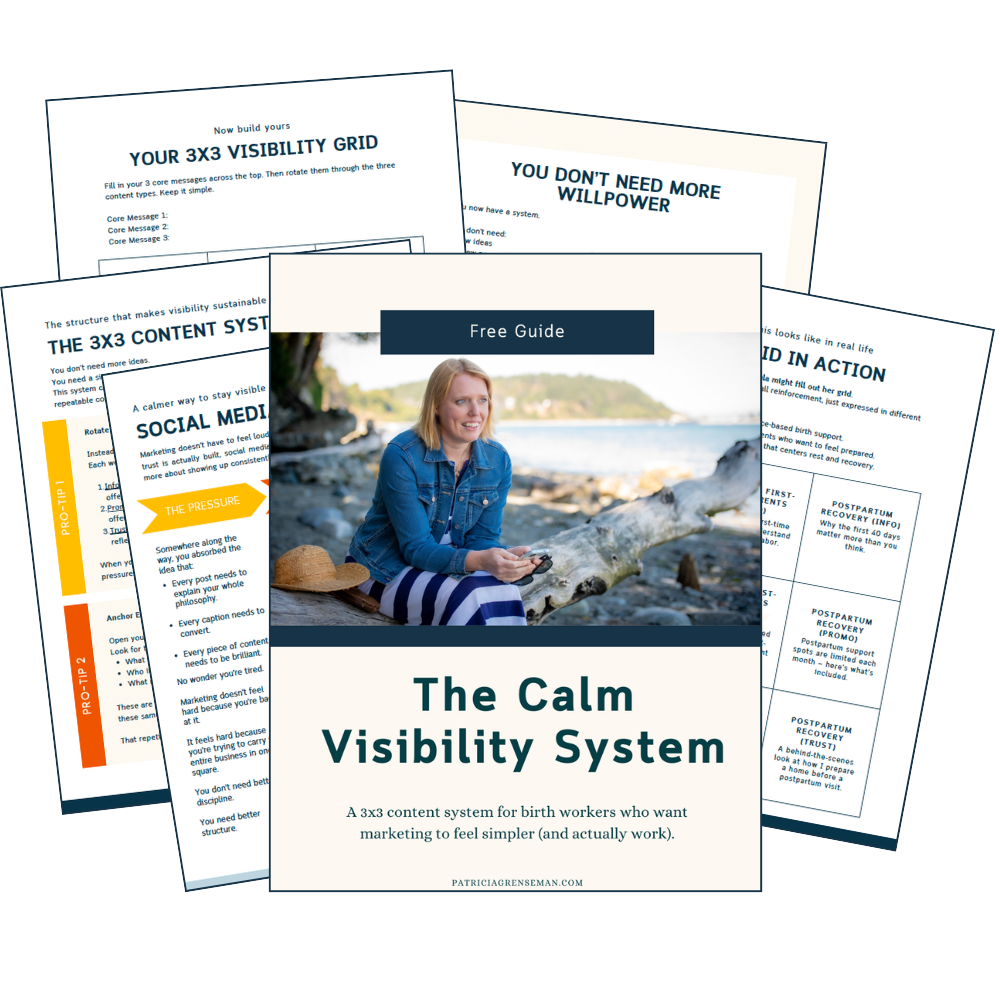
Grab the free guide to make your marketing feel lighter.
They send an inquiry that afternoon.
No single post booked that client. The journey did. Each of the posts did their part.
Most birth workers create content one post at a time, thinking of each caption as their one shot at reaching someone. But that's rarely how a booking actually happens. A family who reaches out to you probably scrolled through four or five of your recent posts first, getting a feel for you and building a picture. What persuaded them wasn't any single post. It was the way each one reinforced the next. The cohesion of what they found made it feel good to reach out
That's what the Booking Journey builds over time: a body of content where the pieces work together, even when you wrote them days apart.
And here's the quieter benefit nobody talks about: the more consistently you rotate through these three types of content, the less charged each individual post feels. You stop trying to make every caption do everything. You stop staring at a blank screen wondering what you're supposed to say or what will get someone’s attention today. You just ask yourself which station you're posting from and you go from there.
Over time, your content works for your business even when you're working with your clients, which is exactly how it’s supposed to work.
What Goes Wrong When One Station Is Empty
It's worth thinking through what goes wrong when one piece is consistently missing because for most birth workers, it’s not that they’re avoiding all three types. It’s that they're likely just defaulting to one.
If you only post informational content, your audience may learn all the tips, tricks, and hacks from you and still never clue in that you have a business with services to offer. You become a helpful presence that nobody knows to hire.
If every post is about availability or pricing, your feed starts to feel like it's only running commercials. Families scroll past because they haven't yet been given a reason to care.
And if you share your expertise and promote your services but never let people see the values, the perspective, the person behind the work, families will love the idea of a birth worker without feeling any particular pull toward you specifically.
All three stations need to be staffed. That's what creates movement.
A Few Questions You Might Be Asking
"Won't people get bored if I keep posting the same three things?"
Probably not and here's why: most people aren't seeing everything you post. And the structure of the framework isn't "same post, repeated every Monday." Instead, think of it as: same station, fresh kiosk. You can answer different questions, tell different stories, share different reflections, and offer different invitations. The category stays consistent; the content itself stays responsive and current.
"My audience is so small. Does this even matter?"
Yes. Even five people in your waiting room deserve a well-furnished one. Small audiences still need clarity. They still need reassurance. They still need a clear door to walk through. And smaller audiences are often paying closer attention than you'd expect.
"I already post, but nobody books."
This is usually a sign that one or two stations are being missed. Maybe people trust you but don't understand your offers. Maybe they see your services but don't yet feel emotionally connected. Maybe your content teaches well but never extends an invitation. One post type alone rarely completes the journey. It’s the rhythm across all three that moves people.
A Simpler Way to Stay Visible
If this framework sounds useful but you're not sure where to start, here’s my invitation for you. The Calm Visibility System is a free resource that helps you map your three core messages across these content types so you always have something to post and you always know why you're posting it. Sign up here to get the Calm Visibility System.
And if you'd like a steady source of prompts delivered to your inbox every Monday, that's what AIME is for. Members get five low-lift prompts each week — one for each content type, plus a long-form prompt and a business support prompt — so the thinking is mostly done before you even open your app.
It's a quiet structure for staying consistent, even in the seasons when your capacity is low. Learn more about AIME here.
